
Our Scientific Advisory Committees
Hub Scientific Advisory Committees (SACs) make recommendations related to technologies and equipment; each covering a different scientific field. Each Committee’s membership is comprised of representatives from our seven partners. One of the key functions of these groups is to help inform the Major Equipment Committee’s priority list. Members’ responsibilities may include:
- Driving Technological Advancement
Working with you to identify strategies, tools, and techniques that keep Facilities aligned with emerging scientific developments. - Championing Researcher Needs
Representing your feedback to ensure Facilities operate smoothly and meet the demands of complex research projects. - Strategic Alignment
Coordinating Facility plans with the priorities of MRIs, the Westmead Research Hub, and key collaborative partnerships. - Core Equipment Recommendations
Advising the Major Equipment Committee on essential instruments that support cutting-edge research. - Grant Guidance
Assisting with equipment grant applications to help secure critical resources for your work.
Biobanking
Meets bi-annually to discuss matters and equipment needs of the Westmead Biobank.
Chaired by Prof Christine Clarke (USYD; WIMR), with Secretariat Roshni Sharma (PrecisionGo; WIMR).
Bioinformatics
Meets monthly to discuss bioinformatics projects and opportunities at Westmead.
Chaired by Prof Denis Bauer (CSIRO), with Secretariat Dr Laurence Wilson (CSIRO).
Bioresources
Chaired by Dr Monica Miranda Saksena (WIMR), with Secretariat Kim Hewitt (WIMR).
There is currently a vacant co-chair position available.
Cytometry
Chair: Dr Kirstie Bertram (WIMR), with Secretariat Secretariat: Edwin Lau (WIMR)
Genomics
Chair: Dr Dinny Graham (WIMR)
Deputy Chair: Dr Jackie Chan (WIMR)
Secretariat: Joey Lai (WIMR)
Imaging
Co-Chair: Leigh Nicholson (CMRI)
Co-Chair/Secretariat: Hui Zhang (WIMR)
Proteomics
Chaired by Dr Mark Graham (CMRI), with Secretariat Josh Studdert (CMRI)
Hub Major Equipment priorities and processes
The Hub relies on its Scientific Advisory Committees (SACs) to make recommendations related to technologies and equipment; each covering a different scientific field. All Hub Committees comprise of appointed members from our seven partners.
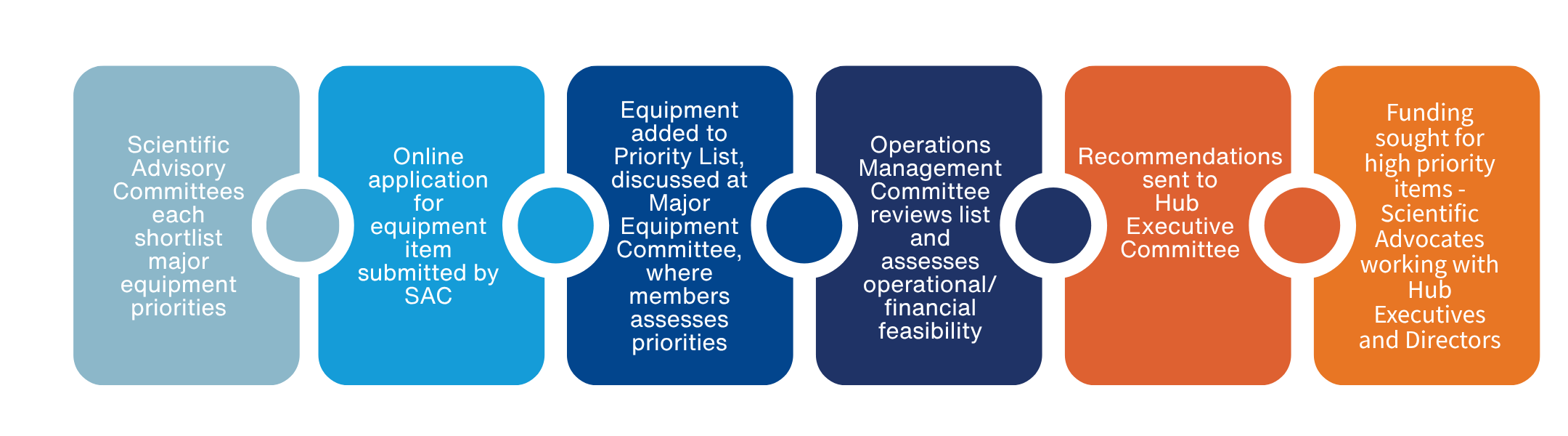
The below diagram broadly maps the process by which items are added to our priority shortlist (sometimes referred to as a roadmap). The online Major Equipment Application form must only be used for items already endorsed by your Scientific Advisory Committee.
Major Equipment Priority List
Below is a high-level version of the current Major Equipment Priority List, it is not ranked.
Last updated: 19 September 2026
Orbitrap Exploris 480 Mass Spectrometer and Vanquish Neo UHPLC System
This system will provide modern, high‑performance proteomics capability to support a wide range of biomedical research. It will enable researchers across Westmead to undertake complex protein analysis with greater consistency and capacity.
Cytek Aurora CS cell sorter
This system will support high‑parameter cell sorting aligned with modern spectral cytometry workflows. It will strengthen shared cytometry capability across immunology, cell biology and translational research programs.
COMET™ spatial biology platform [Under Procurement]
This platform will enable highly multiplexed spatial analysis of proteins and RNA within tissue samples. It will add complementary capability to existing genomic technologies, supporting more integrated biological insight.
Elyra 7 super-resolution microscope
This platform will offer advanced live‑cell and super‑resolution imaging across multiple modalities in a single system. It will expand imaging capability for researchers studying fine cellular structures and dynamic biological processes.
Precision X-Rad320 irradiator
This equipment will support preclinical research requiring controlled irradiation in animal models. It will maintain essential on‑campus capability for a range of established research programs.
Interested in getting involved?
Get in touch with us to find out more!